What’s causing my Anxiety?
In this article, we’ll discuss anxiety, what may be contributing to feeling anxious and what you can do to help reduce it.
Have you ever suffered from butterflies in your stomach? A feeling of dread? Sweaty palms? Feeling that you are struggling to get a breath? Feeling nauseous? Or a general feeling of being on edge, startling easily?
Most of us have experienced this feeling at some point in our lives. Often brought about by being asked to speak publicly, awaiting a job interview or waiting for life-changing good or bad news. It's normal, it serves a function, and we wouldn't be human without it.
But what do we do when it seems to stay? When the feeling appears to come on for no reason and then doesn't leave us?
Anxiety is one of the most common problems in the modern world and one that I regularly come across as a nurse and life coach. It can be one of the most challenging things to overcome.
The Function of Anxiety
Anxiety has a wonderful function. Anxiety states are produced by hormones as a result of the inbuilt 'fight or flight' mechanism - to prepare us to - well - fight or run the hell away when there is a reason to do so. A very basic, primitive response to an acute potentially dangerous situation; sabre-tooth tiger? Earthquake? Car heading directly for you? When you need a quick reaction to defend yourself, the body is all ready to go; stimulating the sympathetic nervous system, the system that operates (unconsciously) for movement, action, excitement. This induces a temporary stress response, and the body will react and then right itself as soon as possible.
In the short term this stress response also helps get our immune system in gear for healing if we get wounded, increases our heart rate, blood pressure and breathing to get more oxygen into our body for movement, (A wonderful author about stress is Robert Sapolsky, who wrote the book "Why Zebras Don't Get Ulcers "- see a great three-minute video clip by him below).
However, the modern world, on an ordinary day, requires little reason for us to fight or abscond. And although we may need to think quickly on our feet from time to time, the ongoing need for our bodies to be in preparation for urgent action is not necessary. Somewhere along the way, our minds have learned to 'overinterpret' possible threats that don't require physical exertion (being late for work, getting yelled at by the boss, a negative, upsetting memory or email) but still creates the same chain reaction in our brain/body.
Diagnosis Of Anxiety
There are several categories of Anxiety disorders, as categorised by the Diagnostic and Statistical Manual of Mental Disorders (DSM), from a generalised anxiety disorder to more specific disorders such as social anxiety disorder or OCD. And although anxiety is a natural phenomenon, there are signs to suggest that it might be getting out of hand - and when you should seek help. These include: constantly feeling worried, avoiding social or other situations due to feeling anxious, out-of-the-blue panic attacks, unable to do usual activities, or repetitively checking locks or washing hands over and above the need to do so for safety or hygiene.
CBT (Cognitive Behavioural Therapy) is recommended to help deal with states of chronic anxiety, and there are other modalities such as Havening, Tapping and EFT. But there are a few things you can do to help yourself overcome milder forms of anxiety.
Psychological Tips to help with Anxiety
What’s the trigger? Even though some anxiety may appear to come out of the blue, chances are, there was a trigger. It could be a thought, a memory or an actual minor event which has triggered the anxious state. It can be helpful to identify and get an understanding of the trigger. Unpacking the trigger may help you understand why the anxiety has occurred in the first place, giving rest to the idea that 'it comes out of nowhere'.
What is the worst that can happen? For anxiety around specific events, it can help to ask 'what's the worst that can happen?', and 'what is the likelihood of what I am fearing happening?' In most cases, the worst imaginable isn't that bad, and the likelihood of it happening in the first place is often very unlikely.
Meditation and Mindfulness practice have also been shown to be useful in combating anxiety - bringing yourself back to the present moment - can be enough to allay your fears and help you to feel more in control.
Ground yourself using your five senses. Using a different part of the brain can help distract and reduce anxiety. So, in the moment, look around you, name five things you can see, five things you can hear, five things you can touch. Connect with these five things.
Labelling the anxiety. Understanding that what you are experiencing is anxiety can in itself be quite helpful. Naming the anxiety (indeed labelling emotions) has been found to take the sting out of them and decrease the area in the brain associated with anxiety.
Looking for the good: Mild anxiety (for example, for a job interview or meeting new people) can sometimes be lessened by asking yourself, "What is perfect in this moment right now?" and agreeing to enjoy the process rather than being fixated on the outcome - i.e. instead of focusing on whether you will get the job or not or whether the people will like you, focus on the journey, the getting ready, the actual interacting with people as it occurs - let go of future forecasting the outcome (positive or negative).
Accepting that anxiety is present, having an understanding of what it is (it's just' anxiety), can sometimes be enough to allay your fears and help you to feel more in control.
Helping anxiety with lifestyle choices
Many people I have worked with have reduced their chronic anxiety by changing their lifestyle. Don’t underestimate the power that this can have!
Diet: Low or fluctuating blood sugar levels can impact anxiety. The peaks and troughs of blood sugar can cause a stress response, releasing stress hormones and contributing to feeling anxious. Soft drinks, energy drinks and highly processed food (junk food) can cause spikes and lows which may be making you anxious.
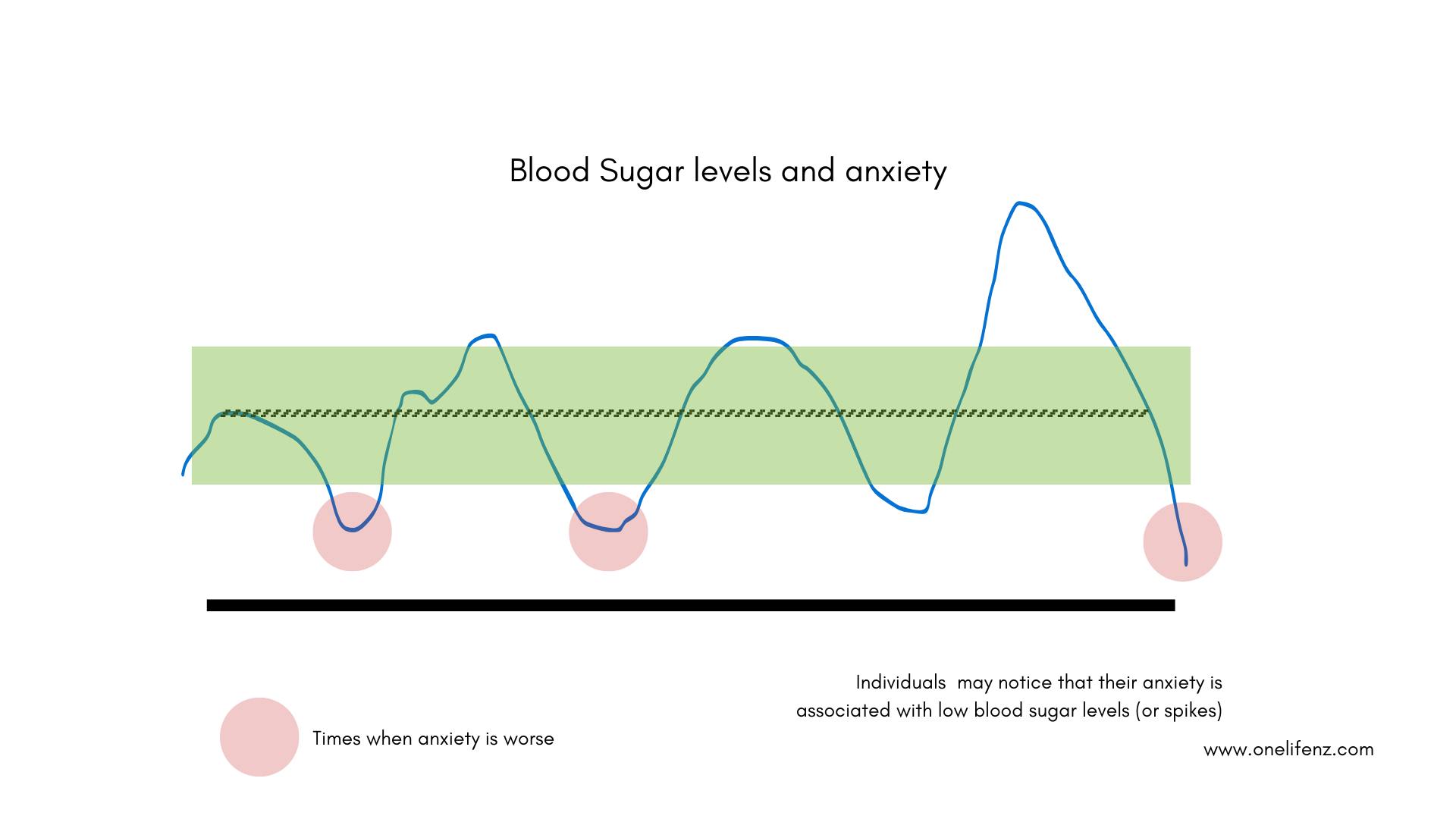
What might be occurring in moment of anxiety. Correlation between low blood glucose levels and feeling anxious.
Going without food for a long period may also be contributing to low blood sugar. Having regular meals and snacks that have protein and fat (nuts, seed, avocado) can be helpful.
(To help you - fill in a food/mood diary sheet (you can use this as a template - but it includes gut issues as well)
In general, diets which contain fruit, vegetables, wholegrains, quality protein and healthy fats such as found in avocado or salmon have consistently been found to be better for mental health. Diets that are heavily processed, low in nutrition, are consistently found to be worse for mental health.
Coffee and caffeine can make anxiety worse.
Alcohol disrupts your sleep quality and raises your stress hormones the following day. Anxiety reduces, and a mood can improve when the ‘couple of glasses of wine’ (or beer) they have each day stops. Even if you’re sure it’s not making any difference, it’s worth stopping for a week or so to see what you find.
Gut Health: Research is now also indicating that having good 'gut health' may have an influence on mental health - (see my blog on gut health). You might want to improve your gut health with prebiotic and probiotic foods. In fact, this study (small as it is) showed how eating yoghurt appeared to have an impact on brain functioning.
Sleep is essential for good mental health. Make sleep a priority (see more on sleep here). Try to get eight hours on average; being tired and irritable is likely to lessen your coping techniques.
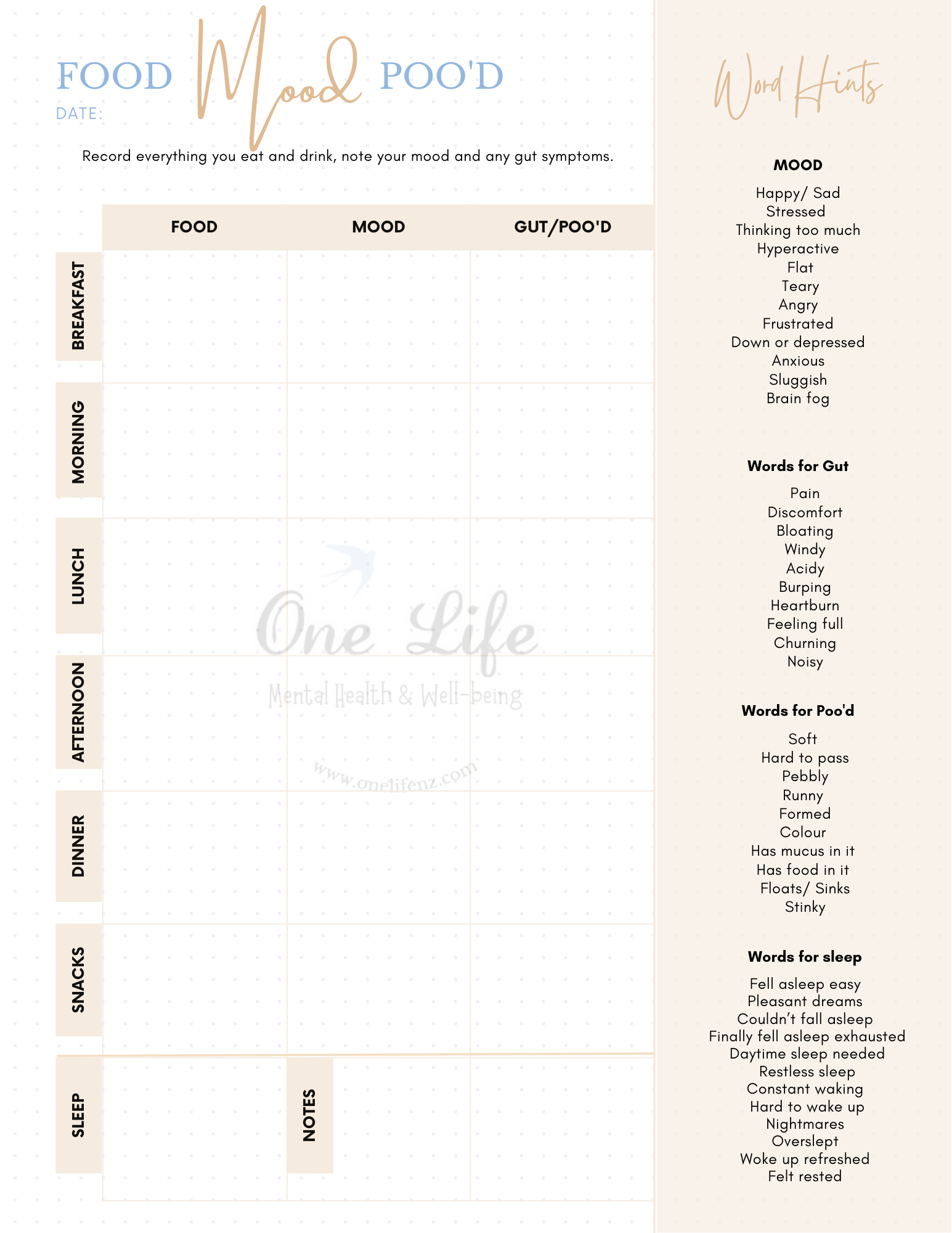
Download a Food/Mood diary sheet as a template
Exercise and being in nature both have been shown to reduce anxiety. It doesn’t really matter how you move, but moving your body will improve your mental state and reduce your anxiety. Regular exercise can help rid the body of the buildup of adrenaline and other hormones that are released when you are feeling anxious. Activities such as yoga and tai chi can be very calming and invoke the parasympathetic (calming) nervous system.
Other Techniques
Breathe! When we feel anxious, our breathing often changes. Instead of short, shallow breathing or taking deep chest inhales, focus on long, slow, belly breaths. A simple ‘breathe in for four and out for six’ (through your nose) can be a good place to start. (I personally don’t like box breathing for anxiety and would not advise this). In short, slow your breathing right down, especially the exhalation. If you're really anxious, it may help to purse your lips and breathe out through your lips, (but breathe in through your nose.) If you need to count the lengths of your inhale and exhale and extend them by a second or so each breath until you can lengthen them to a comfortable, slow, long breath.
Practice belly breathing when you are not anxious - this will make it easy to engage in the necessary technique when you start to feel anxious.
The other breathing technique research has found helpful is the ‘physiological sigh’. Take a deep breath in, hold, then sip in a little more air, then sigh it out. Do this three or so times.
Finding flow: Some people find adult colouring-in very calming, but any activity that promotes a 'flow state' can be helpful. A favourite hobby, playing an instrument, sewing, crafts, knitting or something that distracts your mind and causes you to focus on something you find both a little challenging and enjoyable, helps to bring you into flow..
Laugh. Not always appropriate - this can release many stressful, tense and anxiety-producing situations - see if there is room for a bit of black humour in the midst of the angst. Or get out your favourite funny cartoons or social media reels.
Supplements for anxiety
Supplements can be helpful. Speak to your medical practitioner to ensure supplements are not contraindicated and do not interfere with medications you are currently taking.
Some medications, including doxycycline, the oral contraceptive pill, omeprazole, antibiotics, antacids, anti-epilepsy medications and metformin, can deplete or reduce the absorption of specific vitamins - mostly of the B variety, but also magnesium and zinc. Nutrient depletion may lead to altered mood states. Vitamins and minerals can be helpful (even if you’re not taking medications. Specifically
Vitamin B12, B6, Folic Acid and Inositol (All part of the vitamin B- complex). Magnesium
Other supplements found to be useful include:
Kava (can affect the liver - recommended for short term use only)
5HTP & L-tryptophan (not to be combined with SSRI's (anti-depressants)
Chamomile
Lavendar
Valerian
Passionflower
It's good to ensure that no medicine (or hormonal contraceptive device) that you are currently taking is causing you anxiety, especially if you have had some medication changes and a recent onset of anxiety.
In summary:
Check that your lifestyle isn’t contributing to anxiety.
Ensure you have 20 mins exercise every day (yoga, Tai Chi are ideal),
Learn a deep breathing ('belly' breathing technique),
Label your feelings. It's OK, it's anxiety, I am safe.
Supplement with high-dose vitamins and minerals, and maybe a herb or two
You might want to do the Changing Lives course, which gives you in-depth details on how to improve your mood. and wellbeing.
Sources:
Mayo Clinic (website)
Anxiety and Depression Association of America (website)
Web MD (website)
The Users Guide to the Human Mind - Shawn T Smith (Book)
Arizona Center for Integrated Medicine (University of Arizona) - Introduction to Integrative Medicine for Mental Health (course)
Robert Sapolksy - Why Zebra's Don't Get Ulcers (book)